









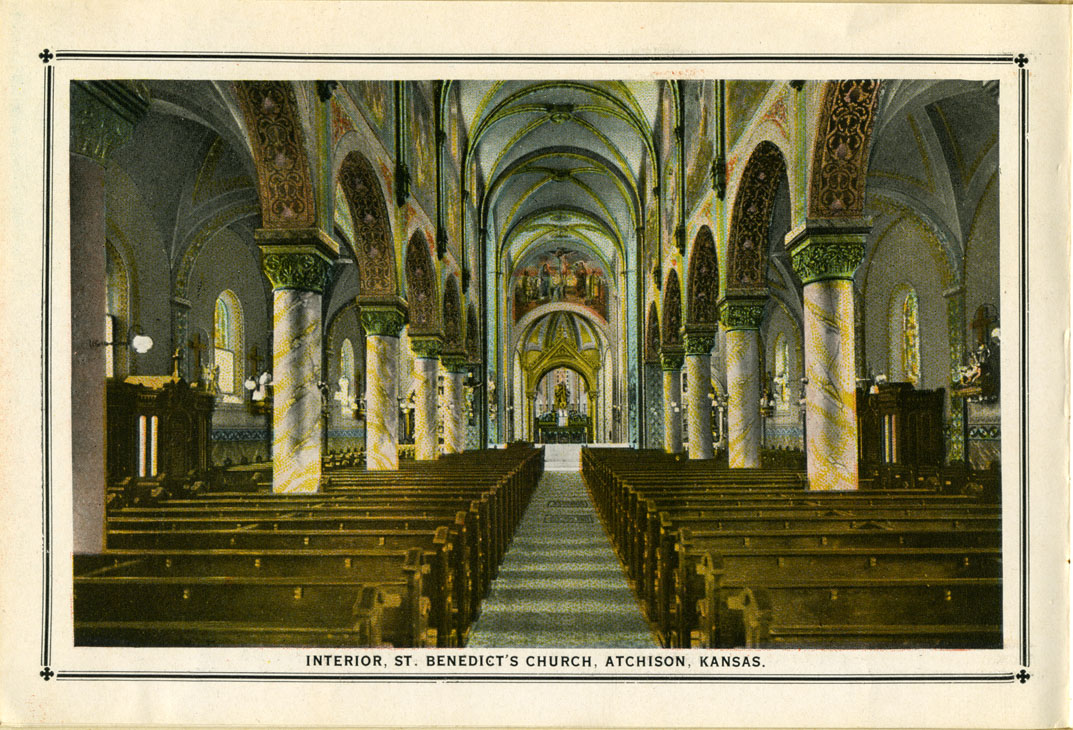
The parish church found on the campus of Benedictine College has a story worth telling.
St. Benedict’s Parish was founded in 1857, where Mass was celebrated by Father Henry Lemke, who would walk 13 miles once a month for the five or six families who would attend.
Now, home to a multitude of families, students, staff, and Atchison locals alike, the parish’s ability to provide daily Masses, confession, and adoration is a gift. Something the catholic parishioners today are abundantly grateful for.
It is often unknown, the suffering and strife of parishioners that came before us– the foundations they laid and the beautiful Churches erected. Churches that we now take place and worship in. They are the unheard of Saints who built our houses of worship, glorifying God with their lives and works. St. Benedict’s Parish was built by a catholic community that struggled and rebuilt twice within its existence, by the strong faith and zeal of their parishioners.
“At 10:15 on the night of May 25, 1903, a tornado struck and entirely demolished the church. The next morning, as Father Matthew stood by the wreckage, he said, ‘The will of God be done! With His help we can build again.’ Before the sun set, workmen were clearing the wreckage in preparation for a new church.” – Eastern Kansas Register 1943
Soon after that in July, a contract was drafted and construction began immediately, the cost estimating to be $25,000 dollars to rebuild the new church. By the grace of God and the zeal of the parish, by December the parish was set to be completed, expressing the same beauty, elegance, and 1890’s Gothic style used by architect Joseph Waitz the previous architect.
From July 23, a predominantly-Irish farming congregation poured their hearts, souls, and resources into building their new church, and on December 20 the church celebrated its first Mass since its destruction.
“The bells of the new church rang out for the first time summoning the congregation to a Solemn Mass of Thanksgiving,.” the St. Benedict Parish Archives said.
You could only imagine the beauty of this Mass in the eyes of the parishioners after the months without it; the emotion, the joy, the relief. Not only does it seem that the church was built in such a timely manner, but it was crafted and designed with such intention and love, capturing the hearts and attention of the congregation and surrounding news organizations.
“St. Benedict’s Catholic Church is pronounced not to be not only the one of the finest in the state, but one of the finest in the west. The interior view of the church is most pleasing in its artistic arrangement. The statues, paintings, etc., are the work of master hands, their equal being found only in the city churches of the east,.” the Weekly Kansas Chief said.
How admirable it is, that from the desolation of a tornado, a parish came together and produced a church that was more beautiful than before.
In this month of remembering and praying for all souls, let us remember the parishioners who suffered and responded with zeal and hope, let us acknowledge and be inspired by their heritage and legacy, and above all let us be thankful for the work they did allowing us to worship God in a place that is fit for a king.
Father Matthew wrote to his people,
“The building of a church is frequently accompanied by grace difficulties, lack of money, unwillingness to give on the part of some, and dissatisfaction on the part of others, but let me say to your credit, my dear people, by your strong faith, earnestness and zeal for your holy religion, you have not only made it possible for us to accomplish so much work in such a short time, but you have made it a work of pleasure. To build and furnish two brick churches and a ten room brick veneer parsonage, and pay for the same in nine years time, in a parish of not more than fifty families, is a work equaled by few parishes, but surpassed by none. With feelings of gratitude let me repeat, “God bless those who so generously assisted us in our work.’” -St. Benedict’s Church.