


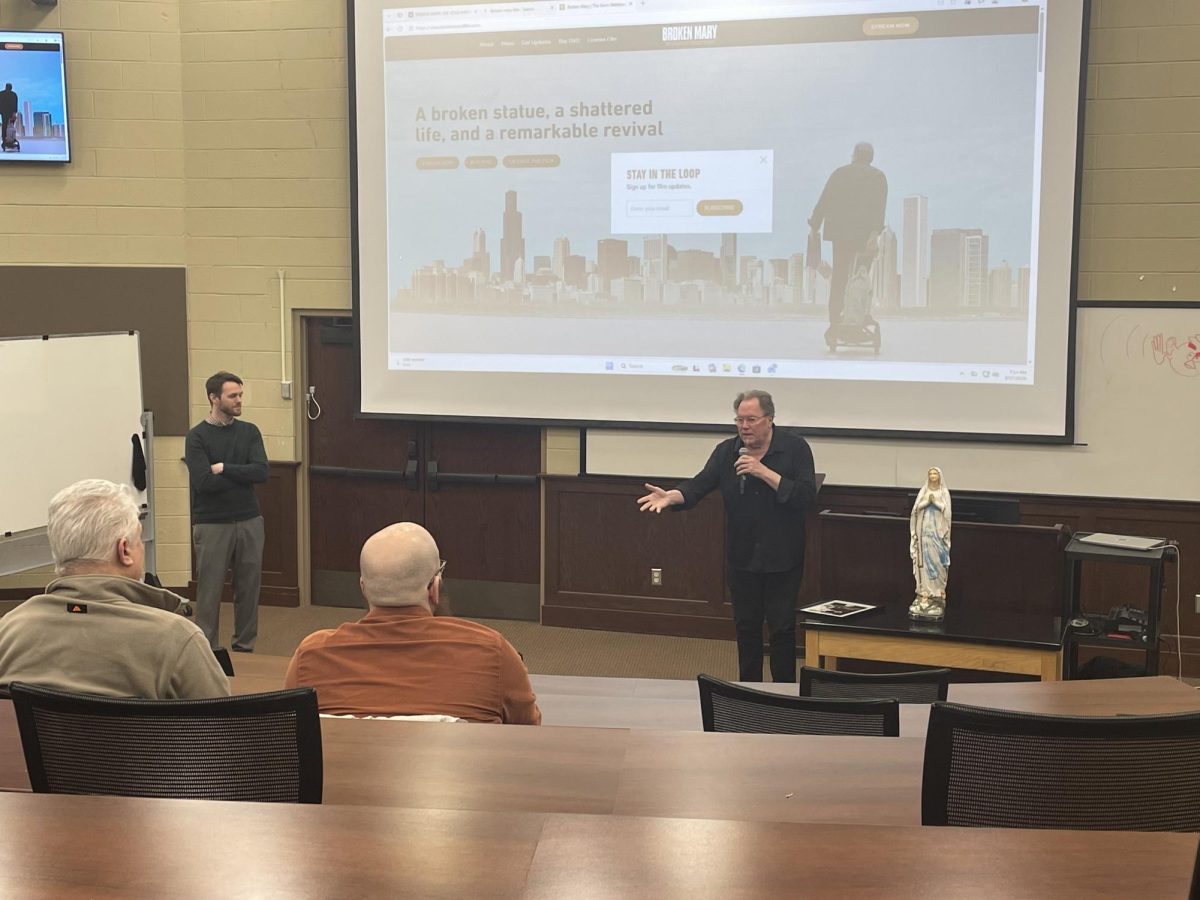





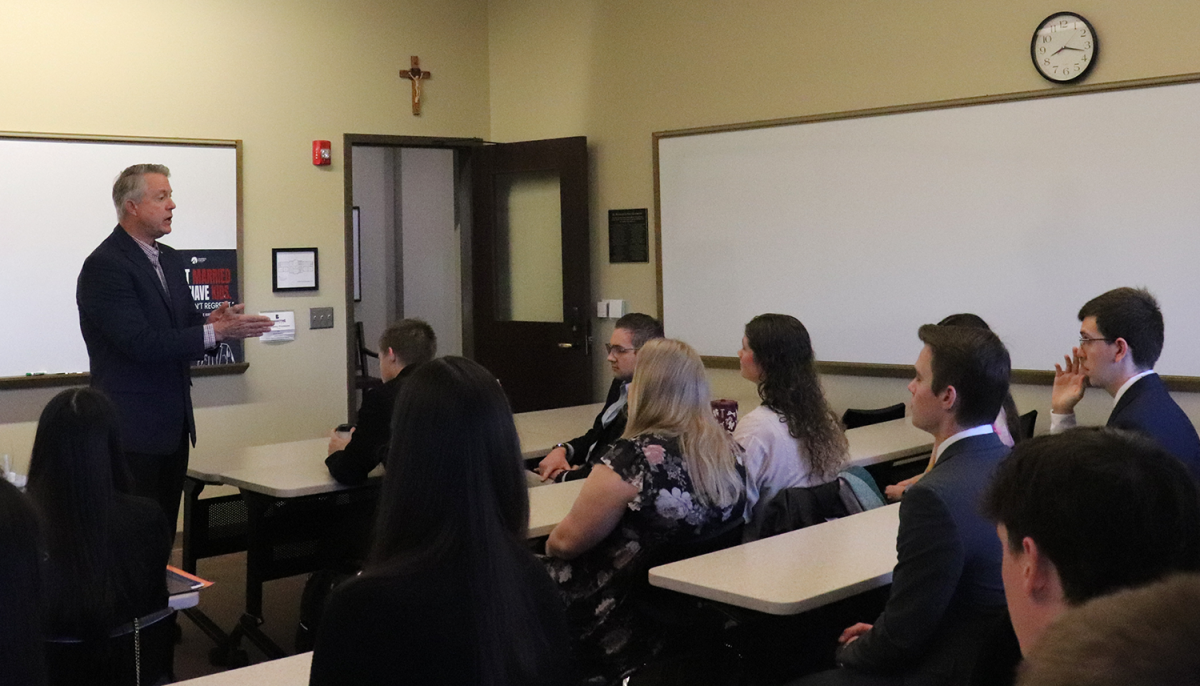
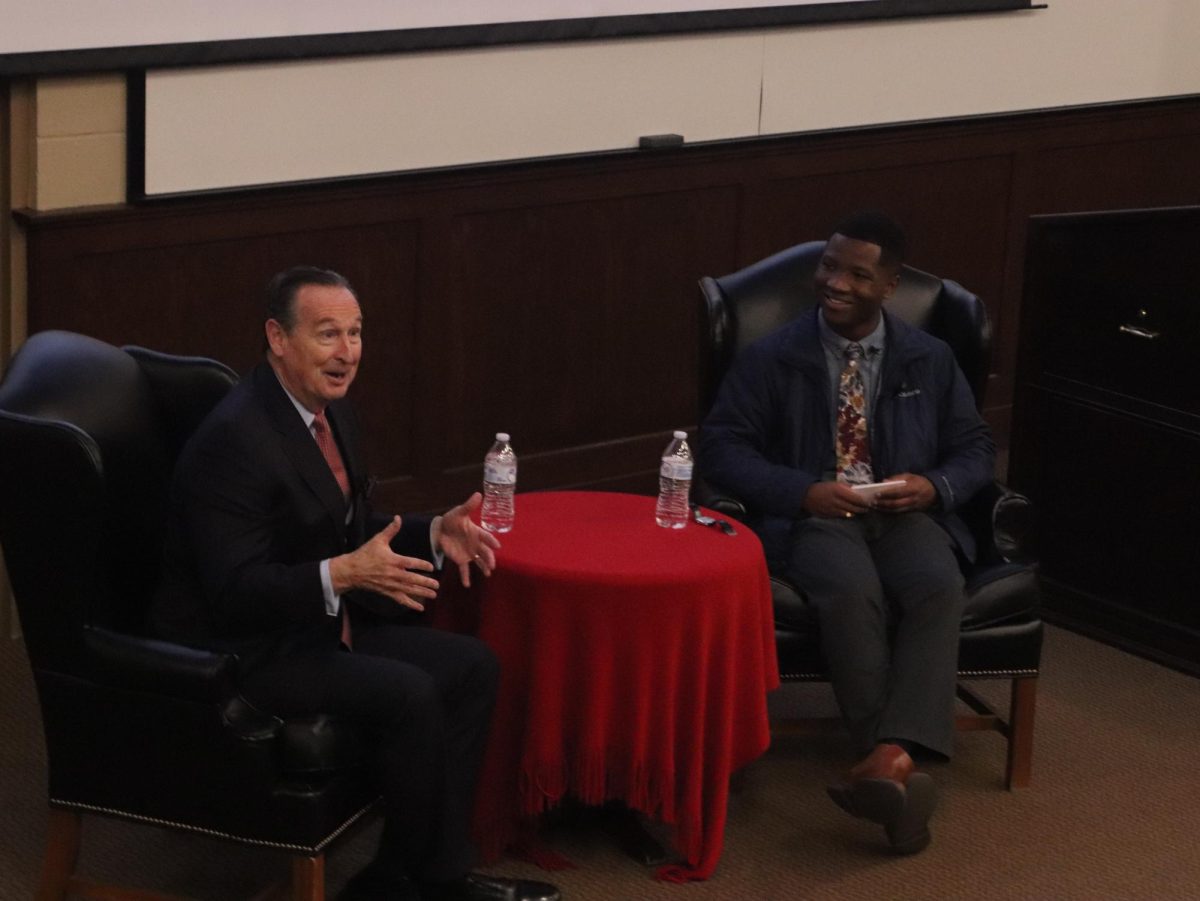








On Monday November 11, Dr. Ben Carson addressed Benedictine College in the McAllister Board Room on the fourth floor of Ferrel Academic Center, touching on topics such as the importance of family, faith, education and courage.
Several hundred students and faculty members were in attendance. The McAllister Board Room was standing room only and many gathered in the hallway outside to hear the retired neurosurgeon, republican primary candidate from 2016, former secretary of housing and urban development under the first Trump administration and leader of the American Cornerstone Institute speak.
“I hope everybody has kind of noticed that things are going a little awry in our country recently and I want to talk a little bit about that,” Dr. Carson said. “Our country is really a very special place.”
Dr. Carson opened his talk with a short discussion on the writings of Alexis de Tocqueville who visited the U.S. in the1831 and how he was impressed at what he saw in the young country, in the government, business and economic functions especially relating to entrepreneurship innovation and the universality and rigor of the education system.
Pivoting to the present day, Dr. Carson noted how things have changed.
“If you really want to be impressed, take a look at a sixth grade exit exam from 150 to 200 years ago in this country. What you were expected to know to graduate from the sixth grade – it is absolutely mind boggling, particularly when you look at some of those man on the street interviews that you see these days. They go out and they ask people just the simplest question and they have no idea what you’re talking about. I mean, you could ask them who wrote Mozart’s 40th symphony and they wouldn’t know,” he said. “It’s just really, really sad.”
The solution he proposed for the wide indoctrination that is hurting the United States is simple.
As he says, “the solution, or one of the big solutions to indoctrination, and the kind of indoctrination that is detrimental to our country, is knowledge. All the knowledge that you can possibly acquire, all the reading that you can possibly do, all the perspective that you can possibly gain and then spread that around in your sphere of influence.”
Sharing a story from his own childhood, Dr. Carson told of how the other kids all called him “dummy” in fifth grade and he brought home bad grades from school.
“That ignorance was cured by my mother because she had tremendous faith in God,” Dr. Carson said. “She asked God earnestly to show her – to give her the wisdom of how she could get her young sons to understand the importance of education, of knowledge.”
The answer that his mother, who had received less than a third grade education, came up with was to have her sons read books and stop watching TV so much, an arrangement that took Dr. Carson some time to get used to.
“As I read all of those stories,” he shared, “I began to understand that the person who has the most to do with what happens to you in life is you. It’s not somebody else, it’s not some circumstance.”
As a student, he said that it is important to “learn how you learn.”
“Figure what works for you,” he said. “Everybody learns in a different way, and if you can manipulate your learning into what works for you, you’re going to go much further and much faster. And that’s really the key.” Knowing how he learned was what helped Carson excel in medical school.
Carson also spoke of the importance of faith and how letting God guide your life can produce the most amazing results. He shared a story from his residency showing how trusting God enabled him to risk his career to save a man’s life and earned him the praise of his superior.
Allie Matthews, a junior Theology and Evangelization and Catechesis major and Constitutional Fellow, shared her main takeaways from the talk with the Circuit.
“We shouldn’t let all the things that should limit us do that,” she said. “Overcome the adversity in your life, and you will be successful beyond measure, not just in your career but life as a whole.”
She also shared how Carson’s talk broadened her perspective on indoctrination and helped her see how widespread it has become, especially in media and within the school systems.
“I view my role as a citizen all the more importantly to combat against this indoctrination. Paying closer attention to policies and initiatives to see if they are adding to or helping remove it,” she said.
Dr. Carson concluded his talk with a call to courage saying, “with knowledge and courage. Imagine what you can do, what you can do for God. What you can do for your country, what you can do in your sphere of influence. And think about all of those people who came before you in this country, people with courage, people with knowledge, people who were innovators, who were making life better for others,” he said. “Now, it’s our turn to do it for those who are coming after us. Let’s pick up the mantle, and let’s be brave, and let’s be knowledgeable, and let’s be used by God.”