












































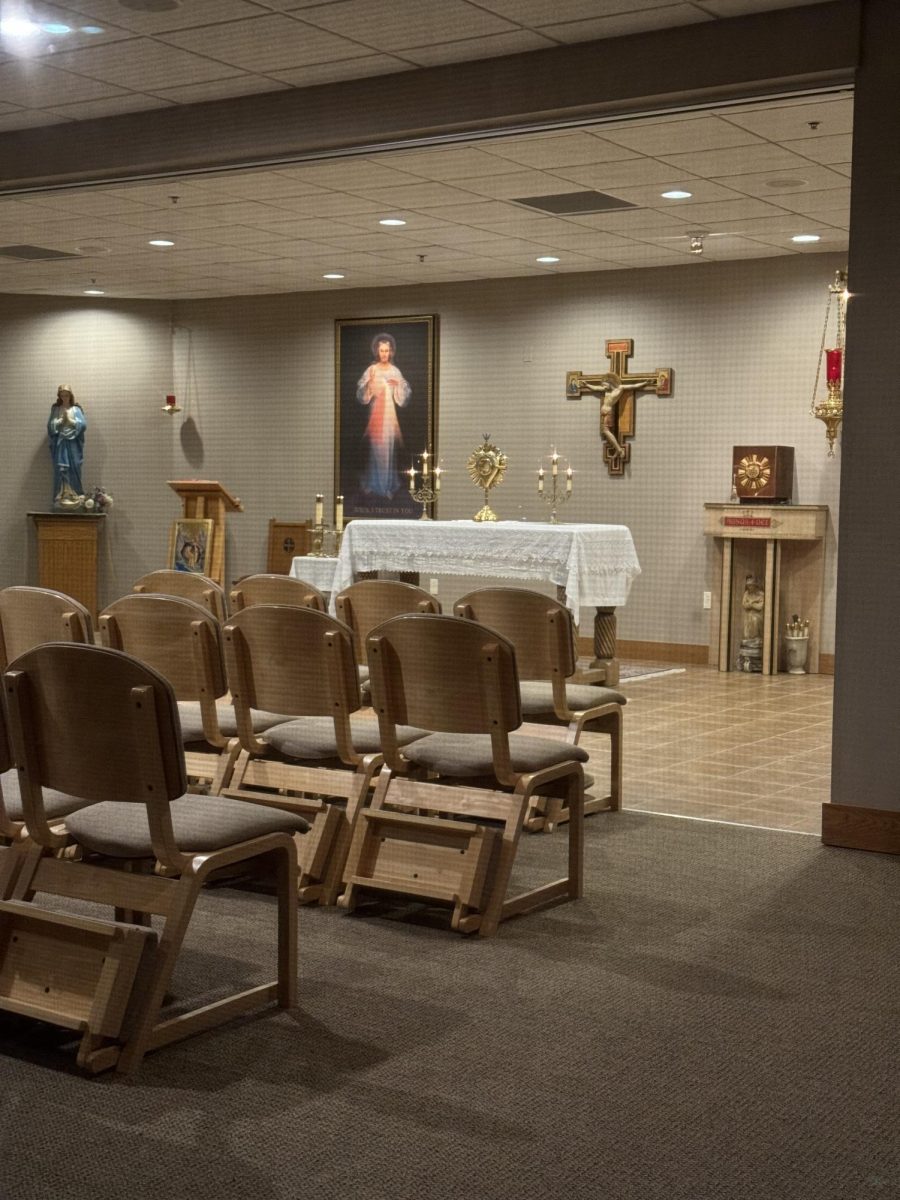
On Friday, Feb. 13, I traveled with three other Benedictine College students to South Dakota for a silent retreat with the Sisters of Life.
The retreat illuminated, both through experience and in inscriptions around the center, the truth that “in the silence, God speaks.”
Our highly competitive culture often drowns students with pressure to perform and be productive amidst many other distractions. With notifications buzzing, group chats exploding, music while studying and movies before bed, college life is constantly overwhelmed by noise. Silence, therefore, is more necessary than ever, especially for Christians. While it may seem like an escape from college life, it’s actually a remedy for it, allowing one to become more attuned with and deeply invested in reality.

In silence, there’s no one to impress, nothing to produce and no one to watch. It’s space for creation to simply be with its creator. Silence is more than the absence of noise; it also exposes the heart. This exposure requires tenderness, although easily resisted. To have a tender heart means allowing it to become soft, just as tissue softens and grows sensitive when bruised. It is precisely this softness that gives God space to shape and to form our hearts to be more like his, as a potter molds clay.
Yet, tenderness is not without pain. Bruises are sensitive, especially when touched in specific ways. Similarly, allowing one’s heart to become tender doesn’t promise comfort, ease or protection from pain. Rather, it requires a willingness to be vulnerable and to trust in God that he’s at work even in the ache.
Silence is much like this. At first it can be uncomfortable, stirring restlessness, uncovering hidden fears and desires, sparking new questions or revealing unprocessed emotions. It has a way of brutally exposing raw wounds that distraction and noise try to numb. Silence creates the space for God to gently work, shaping even our most sensitive places into something more like his own heart.
At the beginning of the silent retreat, I expected something somewhat dramatic to happen, like a breakthrough, sudden clarity or powerful emotional moment. All I experienced, though, were the sounds of the breeze over the South Dakota plains and my thoughts.
Eventually, however, as I let go of expectations and embraced the silence, I began to hear the Lord. I found that the reason I couldn’t hear him before was not because he wasn’t talking, but simply because I wasn’t listening. He doesn’t compete with chaos. It reminds me of Elijah on the mountain in the Old Testament. He waited for God in the wind, the earthquake and the fire, yet found him instead in a whisper as a “still small voice” (1 Kings 19:12).
Like Elijah, we won’t be able to hear the Lord if we don’t take time to listen for him in quietness. Elijah isn’t the only example Scripture provides: Christ himself models this method of withdrawing into silence.
Multiple times in the Gospels, Jesus distances himself from others to be in silence, prioritizing communion with the Father (e.g., before choosing the 12; after feeding the 5,000; in the Garden of Gethsemane before his crucifixion).

What would it look like if college students embraced silence? If they studied in places other than noisy coffee shops or with earbuds in? What if they embraced occasional leisure and silence over constant productivity and noise, even allowing themselves to become bored at times?
They would be able to more fully enter into reality—to have a deeper grounding in and appreciation for the transcendentals. It’s difficult, though. I know. Embracing leisure and silence is a radical act of faith: it allows one to acknowledge they don’t have to actually do anything to be good.
Try it: Embrace silence and leisure. Persist through the discomfort, allowing the Lord to transform you—only then will you be able to recognize fruit and learn to hear his voice. In the silence, God speaks. Are you quiet enough to hear him?